Showing posts with label Banned Books Week. Show all posts

Tuesday, September 26, 2017

Banned Books Week: Book Links That 'Speak' For Themselves


Continuing with the theme of Banned Books Week, I have decided to include links that speak for themselves, once you click on them. Since many people are aghast at the idea of BANNING some books from school libraries, I did some Googling, and came up with the following gems that actually make the case for me. I really don't need to state, once again, that certain books are inappropriate and harmful for children (and even young teens, from 13 to 15). Just click on this priceless collection of links, and you will simply see for yourself!  : )


Here's a quote from the article "Parents Say Book Inappropriate For Teens":

"Wando High School parent James Pasley says the book uses foul language, degrades women and people of color, and isn't appropriate to be on a recommended reading list for high school students." (Emphasis mine)

WOW. "....degrades women and people of color...." Yes, by all means, we need to teach our high school kids to be misogynists and White Supremacists.

Here's another telling quote from this article. 

"His wife read "The Hunt Club" and couldn't believe its contents, he said. Students shouldn't be recommended to read that kind of profanity or derogatory treatment of women and minorities, he said." (Emphasis mine)

Well, geez, why not? Aren't we supposed to be TOLERANT?! Of course we need to let our kids read such things! How will they know what epithets to hurl at which groups? How will they learn to express HATE properly?

Unfortunately, the parents in this particular case did not achieve their aim of having the book removed from use in the classroom, but they did get some result -- the book will now come with a warning note about its contents.

Anti-feminists and White Supremacists should be happy and proud. Now the poison comes with "a warning label", and people tend to ignore those.


Monday, September 25, 2017

Banned Books Week: Some Further Thoughts


Note
This post espouses the concept of limited book banning -- for children and young teens ONLY -- on the basis of avoiding any emotional damage that 
may be caused by their reading of certain books.
This post DOES NOT advocate book banning for ADULTS. Nevertheless, if you believe
you might feel offended by the views expressed here, you are warned NOT to continue reading. 
If you wish to leave an opposing comment, 
please remain civil.
Thank you.


Banned Books Week began yesterday, Sept. 24th, and will run until Saturday, Sept. 30th. In view of this, I am publishing this post, which is actually a continuation of a post I published last week, on the same topic.

Last Friday, Sept. 22nd, I participated -- as I do every Friday -- in the Book Blogger Hop, which is hosted by Billy @ Ramblings of a Coffee-Addicted Writer. This hop has been ongoing for several years now. Each week, participants answer a question regarding a bookish topic. For more information, see the link at the bottom of this post.

This past Friday, the question submitted, by Kristin @ Lukten av Trykksverte, was "In regards to Banned Books Week, what are your favorite books that have been banned or challenged?" See the link list at the bottom of this post in order to refer to my answer to this question.

In addition to posting my favorite challenged/banned books, I included some thoughts on book banning itself. What I stated in that post was that I DID believe there should be banning of certain books in school libraries, especially at the elementary and middle school level, although I didn't specify that in my post. However, I did state that I believe children and younger teens should not have access to certain books in their school libraries.

The idea of book banning raises the hackles of all those who passionately support free speech, and this is as it should be. Free speech is, after all, a hallmark of all democratic societies. So then banning of ANY type of information, for ANY age group, seems to go against this basic right. But does it really? I would like to take a closer look. In order to do this, I would like to present a concept that I also discussed in a previous BBH post: the concept of TOXIC books.

This might be a topic not much commented on in the bookish world, as I have come across only one article, from which I've quoted below, that vaguely refers to it. 

I am not, of course, referring to physical toxicity, such as lead poisoning. I'm referring to PSYCHOLOGICAL toxicity, in which the reading of certain books might cause negative psychological effects, such as recurring nightmares and irrational phobias. I really need to do more research on this. At this point, I can only point to my own experience with a book that I believe to be HIGHLY toxic, in the psychological sense: The Exorcist, by William Peter Blatty. I read this novel in my early twenties, and was very adversely affected by it. I had nightmares, and could not sleep well for two weeks after reading this book. Needless to say, I should have NEVER read it..... Of course, after THAT experience, I was not at all interested in seeing the movie. Reading the book was bad enough!

Now, if this book affected me as strongly as it did, and I read it as an ADULT, it should be obvious that, if a child of say, 10 to 12 were to read it, or a teen of about 13 to 15, said child or teen would be affected much more strongly than I was. 

The fact of the matter is, this novel is SO terrifying, it can actually leave permanent psychological scars on whoever reads it. But again, the effects would be much worse on a young mind. 

In an online article titled, "On The Dangers of Reading" (see the link below), by Dr. Keren Dali, of the Faculty of Information & Media Studies, Western University, Ontario, Canada, the author discusses some of the possible negative effects to be encountered by ADULTS in reading certain fiction works. 

Here's a relevant quote from this article:

"Do you remember how good you felt until you read that book about a cheating spouse? Before that, you didn't worry about the faithfulness of yours. You also did not obsess over rare diseases, traffic accidents, bacteria-laced foods bringing on an epidemic, cunning identity theft, or an internet predator lunging at an opportunity to con you out of your life savings. The list goes on. Books deliver ideas vividly, viscerally: readers hear the criminals plot inside their minds, feel the destructive viruses penetrating a human body, and agonize over the betrayal of those whom we love and trust. And this is how reading an enthralling well-written book can result in a nagging worry or fear."

Bear in mind that Dr. Dali is here referring to negative psychological effects on ADULTS. In his article, he also refers to "vulnerable readers". These are readers who are already suffering from some psychological problem, which is then exacerbated through the reading of a specific book or books. There's also the case of readers who are very sensitive, and thus, should not be reading certain books. Again, he is referring to adults. Even vulnerable adult readers, though, are able to take rational steps to counteract the negative effects experienced through the reading of certain books. Children are not well- equipped to do this, and the reason is quite obvious: they simply do not have the necessary emotional/psychological maturity to do so. Nor do they possess the necessary intellectual maturity, either.

The reading of certain books can therefore be DANGEROUS to children and young teens. Should a twelve-year-old be allowed to read The Exorcist? You might say that this is a ridiculous example, as a child that age will probably not have the necessary vocabulary to understand this novel. But how about a GIFTED twelve-year-old, reading above their grade level? What about a fifteen-year-old? Would that be advisable in either case, considering the probable damaging emotional effects of reading this book? In the face of this probability, is it really worth it to insist on NO book banning AT ALL, under ANY circumstances? I really don't think so. A child's psychological health is much more important than the untrammeled defense of the right to free speech.

Advocates of NO book banning AT ALL protest that other parents have no right to limit their right to decide what their children should or shouldn't read. But this is the point that's frequently forgotten: those parents who insist that no books be banned at their children's school libraries are thereby infringing on the rights of the parents that do NOT want their children to have access to these books. 

It's not always the case that a child or young teen will check out a forbidden book. Sometimes they will just sit down with it right there, at the school library, and start skimming through it. If this book were not available in the school library, they would never come across it, and thus, would be unable to look through it. Since most parents are at work while their children are at school, they have no control on when their children visit the school library, or what books they might encounter there.

Public libraries do not regularly ban books. They certainly do receive requests, mostly from parents, to not have certain books on their shelves. Librarians who work at these libraries, however, are under no constraints to honor these requests, whereas those who work in school libraries have a responsibility to the families of their students.

Here are some relevant quotes from the online article, "How Book Banning Works", by Cristen Conger, who writes for the blog HowStuffWorks, and is a contributing writer for Discovery News. She has also published articles for Huffington Post, ABC Science, and MSNBC.com. 

"In fact, a majority of book banning cases relate to works found in school libraries rather than in public ones."

This quote refers ONLY to PUBLIC libraries:

"Only a minority of the requests actually make it through to banning the book from its respective library.

When filling their shelves, librarians do not judge the content of books on whether it would be suitable for all audiences. As public institutions, libraries may not discriminate on disseminating information on the basis of age, sex or race, which means that people can check out whatever materials they choose. That said, libraries request that parents and guardians of minors monitor their selections."

In light of the above, I would say that those parents who want their children to read ANY kind of book out there, and who are concerned about other parents taking away this right through the banning of potentially damaging books at their children's school, should simply take their children to their local public library. The chances of finding objectionable books there are much higher than they would be at a school library. 

At this point, I'd like to state that the American Library Association does not ban books. The Public Library Association, which is a division of the ALA, is in charge of all U.S. public libraries. Conger states in one of the quotes above, that "only a minority of the requests make it through to banning". She may have gotten inadequate information from her sources, though, because the exact OPPOSITE is stated in the Q & A section of the Banned Books website..

At the risk of sounding boringly repetitious, I will again state that I am NOT advocating book banning for ADULTS. I firmly believe that adults are totally free to read whatever they want to, no matter how objectionable the content. Things are totally different where children and young teens are concerned.

I have much more research to do on this topic. So far, though, it should be abundantly clear that SOME book banning is justified; namely, in the case of younger readers who may actually be harmed through the reading of certain books.


Resource Links
(A Night's Dream of Books)
What do you think of this topic?
Please leave a comment below.
If you disagree with the views expressed here, 
please retain a civil tone
 in your comment.
Thanks for visiting!


Friday, September 22, 2017

Book Blogger Hop No. 106: My Favorite Challenged/Banned Books


Welcome to the Book Blogger Hop,
hosted by Billy @


For more information, and 
to find out the topic of next week's question, click HERE.


This Week's Question

In regards to Banned Books Week,
what are your favorite books
that have been banned or
challenged?

(Submitted  by Kristin @ 


My Answer

I would like to make something perfectly clear before I get to this question's answer. There's a difference between banning books for adults, and banning them for children. I am not at all in favor of the former, but very much in favor of the latter. WHAT?! She's in favor of CENSORSHIP?! Well, see, that's the thing. People tend to think in generalities, and to go to one extreme or the other. I am making the case for a middle-of-the road stance. 

Before beginning this post, I did some Googling, and discovered that most books are banned by school libraries, and that the people who want certain books banned are parents.  It must surely be obvious to anyone that children and very young teens simply do NOT have the intellectual and, most important, emotional/psychological maturity to handle certain topics to be found in certain books. Censoring for adults, though, is not necessary, nor is it healthy. Adults can handle these types of topics, and should have the freedom to do so. If an adult wants to fill his/her mind with total GARBAGE, then s/he should be free to do so. Children and very young teens, however, should not have this freedom, in my honest opinion. I certainly wouldn't want my 14-year-old daughter (if I had one) to be reading Lolita, by Vladimir Nabokov, for example. Nor would I want her reading the Fifty Shades of Grey trilogy!! So, if I did indeed have a 14-year-old daughter, I'd be one of those parents actively involved in getting these novels, and similar ones, banned from my local middle school library, for SURE!!

When you click on this link, and scroll down the page, you will see two graphs -- one detailing reasons for these book challenges, and the other, detailing who the initiators of these challenges are. It will be very clear that the initiators, are, nearly in their totality, parents.

Having stated all of the above, let me once more reiterate that there should be NO censorship for ADULTS in a free, democratic society. This is totally UNACCEPTABLE. Besides, who's going to ban books for adult readers? Certainly no government should attempt to do so. But, even in the case of children and younger teens, the U.S. government has NEVER stepped in and attempted to do this. It's always been private citizens -- parents -- who have wanted certain books banned by their children's school libraries.

Another interesting point here is that this challenging of books has to do with libraries. Challenged and banned books are still freely available in bookstores, as well as online, although I've never seen pornography in regular bookstores, like Barnes & Noble. Of course, such books are indeed available online, as well as in adult bookstores.

Now on to this question's answer.

These are my favorite challenged/banned books. They are all YA novels. I don't think that kids should read these books until they're at least around 17 or 18. There are events in these books that might be a bit too scary or disturbing for children and younger teens.  


I do  think you need to have a certain level of psychological maturity to read the books that comprise The Twilight Saga. In my honest opinion, they are not appropriate for kids younger than at least 17. They are beautiful and romantic books, but they also contain concepts that might be too jarring and confusing for younger kids, such as the whole idea of good vampires. How can vampires possibly be "good"? Older teens can see how the Cullen family is committed to not harming humans, how Carlisle Cullen, the doctor who brought them all together, vowed to not give in to the vampire nature, when he himself was accidentally turned into a vampire, centuries ago. 

Edward Cullen, one of Carlisle's adopted children, follows his adoptive father's philosophy, striving not to harm the girl he loves -- Bella Swan. This idea of a man struggling to protect a woman from his baser impulses (because, as I have read in an online article, this is clearly a metaphor), is something that only older teens would be able to comprehend and appreciate.

I was way beyond adolescence when I first read Twilight, the first book in the series, in 2006. I fell head over heels in love with it, and promptly bought the second book, New Moon. Later on, I completed the set with Eclipse and Breaking Dawn. I ADORE these books, and have read them 3 times already! I have read the first 4 times -- 3 times in English, and once in Spanish.

Aside from the vampire metaphor, these books do contain some very laudable values, such as the sanctity of human life, the courage to withstand temptation, the value of family unity, and many others. Adult women of all ages (these books appeal mostly to females) love these books, too, as they are indeed wonderful, exciting reading! 

All four books made the list of "Top Ten Most Challenged Books" in 2009, and the first book made the list in 2010.


The Harry Potter series has also been challenged by parents, and I do think that, again, older teens can read them, but not younger ones, nor children. The thing is, and this has been pointed out by critics of the books, that each novel gets darker and darker as the series progresses. Although I love these books myself, I must confess that I came across some disturbing things while reading them. I was also an adult when I started reading the books, around 2000 or 2001, and I STILL found these things disturbing. One of them was a very macabre birthday party for one of the Hogwarts ghosts, whose name is "Nearly Headless Nick". Nick's head was used in a ghostly polo game.... Thankfully, this scene never made it into the film version! Another thing, and this one DID make it into the movie version, was the grisly ingredient of a severed hand included in a potion meant to bring Voldemort, the villain of the series, come fully back to life.I don't think young children should either read such things, or see them on film, either. 

The Harry Potter series is definitely full of wonderful, magical things, and I don't agree with those parents who say these books are full of occultism. The "witchcraft" in the books is of the sort to be frequently found in fantasy novels. Besides, the spells and enchantments detailed in the books obviously do not work in real life. Lol. 

These books, like those of The Twilight Saga, contain many worthwhile concepts, such as courage, the fortitude to follow one's values even when it's easier not to, loyalty to one's friends, and even family values. This can be seen in the Weasley family, for example.

So these are my favorite challenged, or banned books. Again, I do support the freedom to read, but only if a person has reached a certain level of psychological and intellectual maturity. Of course, there's the case of gifted kids, who are beyond their age group in certain skills. Most likely reading will be one of them. However, these kids may not have the level of emotional maturity to handle certain topics, so I believe they, too, should not be exposed to them.

Reading is meant to be a rewarding, joyful experience. When the wrong books fall into the wrong hands, however, it can then become a terrifying, traumatic experience, or, at best, a very disturbing one.


What are your thoughts on
this topic?
If you're participating in this hop,
I'll go comment on your 
own BBH post.
If not, I will then comment on one 
of your blog posts!
Thanks for visiting!!!  


Friday, September 26, 2014

The Book Lover's Den #5: Banned Books Week -- My Thoughts


Welcome to my Friday feature!

In each weekly post, I explore 
my thoughts on several 
book-related topics.

I will continue with this 
very important issue next Friday.


Governments and religions have for centuries sought to mold or control the character of their citizens and believers by prohibiting the free distribution of certain ideas, mostly those found in books.  The burning of the ancient library at Alexandria, although said to be an accident by some historians, is a prime example. There's also the Edict of Compiegne, the Index Librorum (the Catholic Church's former list of banned books, which was abolished by Pope Paul VI in 1966), and the condemnation of Salman Rushdie's The Satanic Verses by Ayatollah Khomeini. Many more examples exist, not the least of which are the Nazi book burnings in the 20th century.

The First Amendment and Democratic Values

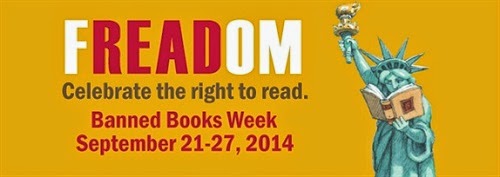
Banned Books Week is a very important affirmation of American democratic values. It was founded in 1982 by First Amendment and library activist Judith Krug, and is sponsored by the American Library Association, as well as several other organizations. It's held every year, during the last full week of September. During this week, there are special programs in colleges, universities, bookstores and libraries.

The whole concept of banning or challenging books -- some American journalists affirm that controversial books are not actually removed from circulation in the U.S. -- is completely antithetical to the First Amendment of the U.S. Constitution, which guarantees free speech. Yet, groups of concerned individuals -- mostly parents with strong religious values -- do attempt to have specific books removed from their local school libraries every year.

Universal vs. Case-Specific Book Censorship

Although I am against book censorship, my opposition is specifically to the attempt by governments and religious institutions to implement and impose it on adults, on a mass basis. This means that I do favor book censorship on a limited basis -- by individuals, and in certain specific situations. One such situation is related to school libraries; I firmly believe that parents have every right to prevent their children from reading certain books they feel would be harmful to their children's intellectual and/or moral development.

I also believe that certain books, as well as magazines, should only be made available to the public on a limited basis. Books and magazines containing pornographic materials, for example, should be set aside in special sections of libraries and bookstores, accessible only by special permission. I might come under criticism for taking this stance, but it is a confirmed fact that pornography, whether in books or videos, frequently depicts women in very demeaning scenarios. Besides, such things as bondage and sadomasochism are highly controversial sexual acts. Only those people over 18 who are interested in such activities should have access to them, not the general public.

Amazon and The Pedophile's Guide: A Case 
of Justified Censorship

A recent example of justified book censorship comes to mind. It concerns the case of Amazon and its sale of The Pedophile's Guide to Love and Pleasure, back in 2010. This ebook was subsequently removed by the online retailer after a huge public outcry. I was among those who threatened to boycott Amazon. I would do so again, should they offer a similar book for sale in the future. Why do I state this? Well, the fact remains that pedophilia is a crime, punishable by law. Worse, it's a  crime against children. This book not only defends pedophiles, but offers 'tips' to help them better perpetrate their crimes, and avoid being caught! This is absolutely disgusting, and I am completely in favor of such a book not being sold anywhere in the United States, or in the world, for that matter.

Here is the author's own description of his book: "This is my attempt to make pedophile situations safer for those juveniles that find themselves involved in them, by establishing certian (sic) rules for these adults to follow. I hope to achieve this by appealing to the better nature of pedosexuals (sic), with hopes that their doing so will result in less hatred and perhaps liter (sic) sentences should they ever be caught."

It's very obvious that the author of this deplorable book, Philip R. Greaves (who seems to have trouble spelling even simple words), is dispensing advice to fellow perverts. Furthermore, he obviously thinks that there's nothing wrong with pedophilia, as long as certain 'rules' are followed! I'd like to know how a minor can possibly feel 'safe' in such a situation!

The Irony of Political Correctness 
vs. Justified Censorship

Those who might disagree with me regarding the protest against this book would do well to consider the irony of criticizing the Catholic Church for its coverup of their pedophile priests, while upholding the right of Greaves to offer his book for sale, and that of Amazon to include it in its stock of books for sale.

This issue becomes even clearer if we imagine Amazon selling a book titled The Terrorist's Guide: The Duty of Holy War and The Pleasure of Political Retribution (I have invented this title; there's no such book), with the stated purpose of defending terrorists, giving them 'tips' to help them carry out terrorist acts more effectively, as well as how to avoid capture by law enforcement agencies. Public reaction would be to swiftly condemn such a book, and prohibit its distribution.  Justifiably so.

It's not that I'm against the depiction of controversial themes in books. While I would prefer not to read such books myself, I would not oppose adults over 18 reading them, if so inclined. What I do oppose, however, is the glorification of themes that are actually crimes punishable by law, to the extent of presenting methods and techniques to put them into practice, and avoid criminal punishment in the process.

I am therefore in favor of book censorship, on a limited, case-by-case basis. As I stated above, I am not at all in favor of universal book censorship implemented by either a government or a religious institution.

As I was getting ready to wrap up this post, I decided to do some research on the Internet to see if I could find any support for my thoughts on the subject of censorship. I found it.

Censorship Isn't Really A Black-and-White Issue

Stephanie Orges is a copy and public relations writer for the largest ad agency in Fort Worth, Texas, and has won many awards. In her 2013 post, titled "5 Reasons Censorship Isn't Black and White" (posted on her blog, Be Kind, Rewrite), she makes some of the same points I do, in different words. For instance, she cites the difference between censoring within a school system, and across the country, with no exceptions allowed, which is basically what I was stating above. She also mentions the difference "between censoring ideas and censoring inappropriate content", something I also referred to above.

I also agree with Orges when she states that it's not always easy to discern when and to what extent something may be deemed inappropriate. However, there are ideas and activities that are considered criminal by every civilized society; such is the case with pedophilia and terrorism. The fact that these types of activities might very well be an accepted part of primitive societies is totally irrelevant to the argument at hand, simply because the concept of censorship, whether or not on a wide scale, is not even part of such societies, or, if it is, it's obviously not a matter for intellectual debate.

Summing up, I would say that the subject of book censorship is definitely not a black-and-white issue, but one that has to be closely examined to see whether it may at times be totally justified.


For Further Information

Banned Books Week


What do you think of my views?
Do you agree or disagree?
Please leave me a comment 
and let me know!


Friday, October 5, 2012

Book Blogger Hop #11 (10/5 - 10/11): Banned Books Week


Welcome to
the Book Blogger Hop!


This is where bloggers and readers
connect every week!

This wonderful blog hop is
hosted by
Jennifer @ Crazy for Books!

Starting this week,
a different blog will be hosting
the hop for Jennifer each week,
until she returns from hiatus.

This week, the host is
Erica @


What To Do:


1. Post on your blog answering this question:

Banned Books Week ends on Oct. 6th.
How do you feel about books
being challenged to be
banned from libraries and schools?
Have you read any banned books?

2. Enter the link to your post in the
Linky list at this week's blog,
with your blog's name, genre you review,
and a direct link to your post.

3. Visit other blogs on the list.
This blog hop isn't about the number of
people you can visit,
but the quality of each visit.
Find new blogs to read by clicking
through the links on the list!


My Answer:


In principle, I am totally against books being banned.  I do believe that people have every right to read any book they want.  This is the principle of intellectual freedom.  After all, books have always been carriers of wisdom and knowledge, as well as adventure, romance, tales of fantasy and wonder.  Banning any book at all is, at first sight, a huge disservice to humanity.  However, important life issues such as this one are very rarely black-and-white, all-or-nothing situations.  While I think that a
mature adult should be able to read anything they please, I am very much concerned that younger age groups may be getting exposed to material they simply can't evaluate without being adversely affected by it, just because they aren't sufficiently prepared to do so, from an intellectual and ethical standpoint.